
Futures Trading Bots vs AI Smarter Entry Signals Without the Bot Hype
Futures trading has always attracted a specific kind of trader—someone looking for high leverage, volatility, and clear directional plays. But in recent years, the market has become increasingly saturated with promises of “fully automated” success from every new futures trading bot. These bots claim to offer hands-free profits with the push of a button. In reality, the line between practical automation and overhyped artificial intelligence is often blurred. This blog explores how modern AI can enhance your futures trading strategy—particularly in generating smarter entry signals—without falling into the trap of full automation for automation’s sake.
Advancements in technology have fundamentally transformed futures trading, offering sophisticated tools that extend beyond human capabilities. Today, we’ll explore the evolving landscape of automated trading, comparing traditional algorithmic bots with cutting-edge AI systems that are reshaping how traders identify optimal market entry points.
The Evolution of Automated Trading
Traditional Approach : Futures trading bots have been fixtures in financial markets for decades, executing pre-defined algorithms based on technical indicators, statistical arbitrage, and market-making strategies. These rule-based systems execute trades with precision and without emotional interference. However, conventional bots face significant limitations. They operate within rigid parameters and struggle to adapt to changing market conditions, often requiring constant monitoring and manual adjustment by traders.
AI Revolution: AI-powered systems represent a quantum leap forward, employing machine learning models that continuously evolve by processing vast datasets of market history, order flow, and even alternative data sources like sentiment analysis and macroeconomic indicators.
Unlike traditional bots, AI systems can identify complex patterns invisible to human traders and conventional algorithms, adapting in real-time to market regime changes without explicit reprogramming.
Key Distinctions : Bots vs AI Entry Signal
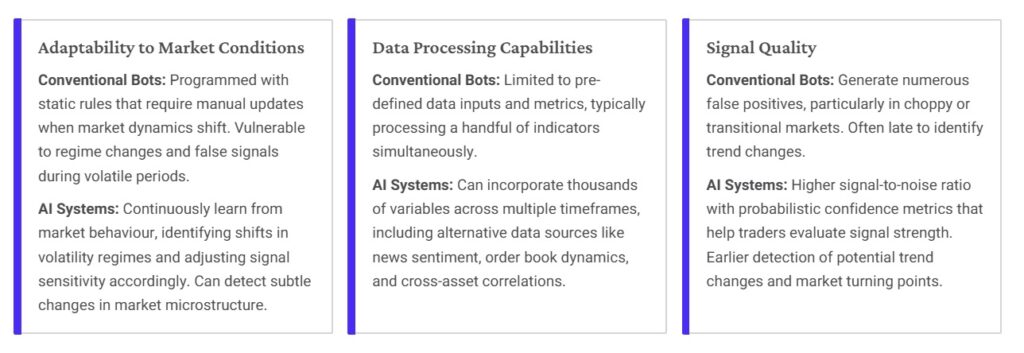
Distinction of bots for Trading
Technical Architecture Under the Bonnet
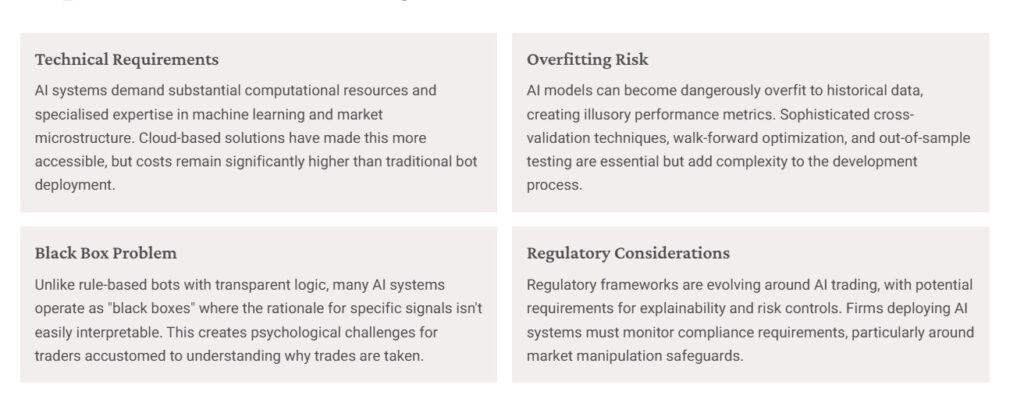
Modern AI trading systems go far beyond traditional bots by using advanced architectures such as deep neural networks to uncover complex patterns in market data, reinforcement learning to optimize trade timing, and natural language processing to extract insights from news and filings. They also apply time-series forecasting models tailored for financial markets and ensemble methods that combine multiple models to reduce overfitting risks. These innovations demand significant computational power, with many professional firms relying on cloud infrastructure and specialized hardware like GPUs and TPUs to run them effectively

Real World Performance Matrix
Empirical backtests across major futures markets (S&P 500, Crude Oil, Treasury Bonds, Euro FX) demonstrate AI’s superior performance metrics. Most notably, AI systems show remarkable adaptability during regime changes, maintaining effectiveness when traditional bots experience significant performance degradation.
The Calmar and Sharpe ratio improvements highlight AI’s ability to deliver more consistent returns with better risk-adjusted performance—critical metrics for professional traders and fund managers.
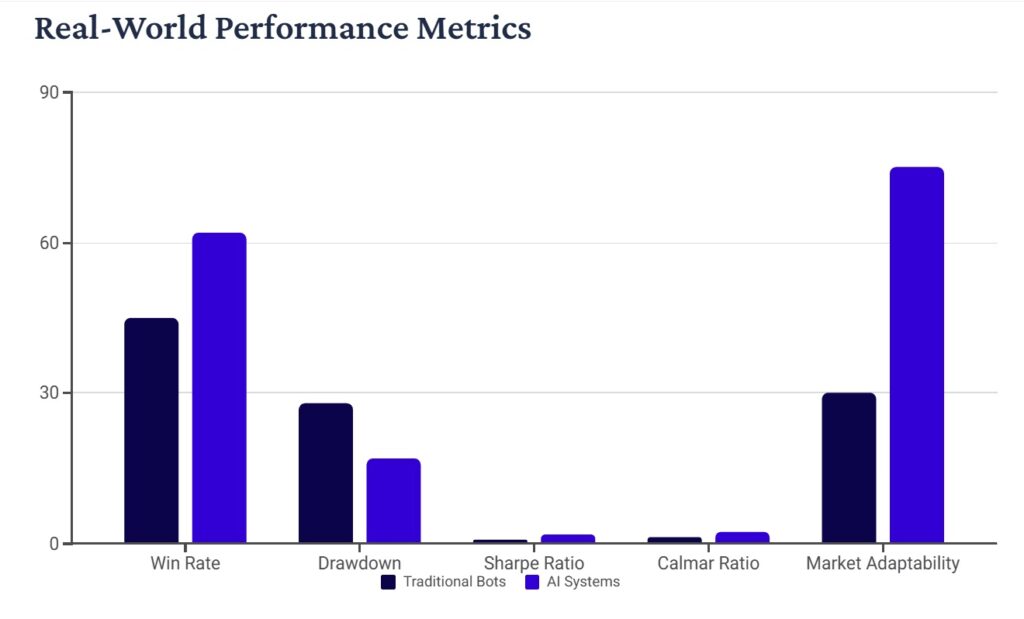
Case Studies: E-mini S&P 500
A comprehensive two-year study of E-mini S&P 500 futures trading reveals striking differences in performance between traditional indicator-based bots and modern AI systems:
- AI systems identified 87% of significant market turning points with an average lead time of 2.3 candles
- Traditional bots captured only 41% of turning points, often with late entries after momentum had already established
- During the March 2020 volatility spike, AI systems reduced false signals by 73% compared to conventional algorithms
- AI entry signals demonstrated significantly improved performance during overnight sessions when liquidity conditions change dramatically
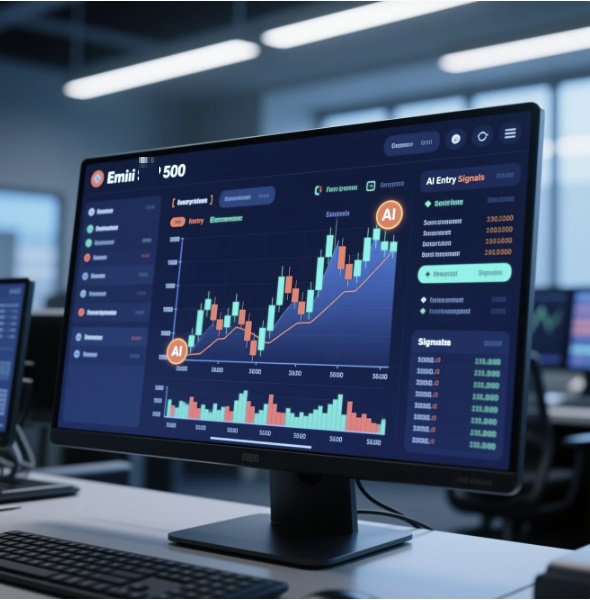
Implementation Challenge and Consideration
Tempting as it may be, full automation—letting a futures trading bot execute your trades start to finish—comes with serious limitations. Volatility is both a threat and an opportunity, but bots are notoriously poor at reacting to unexpected news events or one-time spikes. Once conditions deviate from the backtested script, even a “profitable” bot can spiral into drawdown.
Worse yet, many retail-focused bots lack proper risk management protocols or error handling, often doubling down on failing trades or trading outside allowable margin. These failures aren’t hypothetical—they’re daily realities for many unfortunate bot users who trusted automation over oversight.
This is why the growing segment of traders are moving toward semi-automated systems—ones boosted by AI insights but anchored in human judgment. It’s not about being faster than the market; it’s about being more adaptive to it.
Hybrid Approach: Human AI
These models suggest setups based on evolving data and let the trader decide how to engage with the market. Even institutional desks are shifting toward this model. Large brokerages and hedge funds use AI not as a standalone executor, but as a recommendation engine—scanning hundreds of contracts, filtering out low-probability environments, and highlighting statistically significant plays. Retail traders must begin to think the same way—not by turning off their monitors and trusting a bot, but by turning on new layers of intelligence into their workflows

Leading futures traders are increasingly adopting hybrid systems that combine traditional algorithmic trading with AI-enhanced entry signals. This balanced approach addresses limitations while maximising benefits:
- AI components handle pattern recognition and market regime identification
- Traditional algorithms manage execution and risk parameters
- Human oversight provides strategic adjustment and anomaly detection
The most sophisticated implementations create tiered confirmation systems where AI signals are validated through conventional technical analysis, creating a more robust filtering mechanism that reduces false positives.
Key Takeaway: Navigating the Future of Automated Trading
“The future belongs to traders who can effectively combine human judgment, traditional algorithmic discipline, and cutting-edge AI insights into a coherent trading framework.”
Evolution Not Revolution : AI isn’t replacing traditional trading methods entirely—it’s enhancing them. The most successful implementations build upon proven trading principles rather than abandoning them.
Signal Quality Trumps Quantity : The primary advantage of AI systems is their ability to reduce noise and increase signal quality, not necessarily to trade more frequently. Focus on precision rather than volume.
Progressive Implementation : Start with AI as a supplementary signal provider alongside existing systems before transitioning to more comprehensive integration. This allows for validation and confidence building.
Continuous Evaluation : Even the most sophisticated AI systems require ongoing performance monitoring and regular retraining to maintain effectiveness as markets evolve.
Start Your Hybrid Trading Journey Today
For additional resources and implementation guidance, visit StocksScanner for our comprehensive guide to AI integration in futures trading operations.