
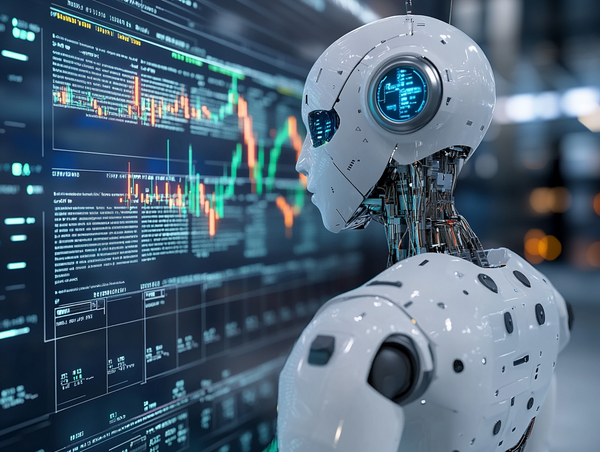
From Bots to Brains: Smarter Option Trading with AI Confidence Levels
In the ever-changing landscape of financial markets, staying ahead requires more than just intuition—it takes cutting-edge technology. Over the years, traders have increasingly turned to Automated Options trading bots to streamline their strategies and remove emotions from the decision-making process. But as artificial intelligence (AI) evolves, so too does the sophistication of these tools. Today, the conversation is shifting from mere automation to intelligent insights powered by AI confidence levels, enabling traders to engage in smarter, more informed option trading.
What Makes Automated Options Trading Bots So Effective?
Automated options trading bots have become a staple for both retail and institutional traders alike. These bots are designed to follow pre-set rules or code, executing trades at lightning speed. They’re capable of handling massive datasets, applying strategies without fatigue, and eliminating the psychological barriers that often undermine human decision-making. But their true power lies in their consistency and efficiency in executing trades without deviation from strategy.
In traditional options trading, emotions like fear and greed can skew judgment and provoke irrational decisions. Bots counter this by maintaining discipline. They process technical indicators, price action, and historical data at a scale no human trader could match. However, despite their growing popularity, early bots were still limited—they simply obeyed their code. Enter artificial intelligence, and the dawn of a new era began.
AI Confidence Levels: Adding Intelligence to Automation
Advanced AI doesn’t just execute trades—it evaluates the probability of success. Through techniques such as machine learning and deep learning, AI systems learn from past performance, market anomalies, and statistical patterns. The introduction of confidence levels allows trading bots to gauge how likely a particular option trade is to succeed based on real-time market conditions.
Confidence levels are more than just numbers; they represent a crucial shift from reactive to predictive trading. Rather than blindly executing every trade that meets basic technical criteria, AI-enhanced bots can now assign values—expressed as percentages or probability scores—to forecast possible outcomes. As confidence increases, so too does the potential justification for trade execution. When the confidence is low, the bot has the intelligence to wait or pass altogether, preserving capital and avoiding unnecessary risk.
Machine Learning Meets Market Volatility
Options trading is inherently complex due to market volatility, expiry dates, and strike prices. Machine learning algorithms thrive in complexity. They can process streams of data in real-time, adjusting to new information as it comes in. This empowers bots to adapt strategies on the go—learning from every trade, recalibrating expectations, and continuously fine-tuning confidence levels.
In volatile markets, this flexibility is invaluable. Where older bots might rigidly follow a strategy into a loss, AI-powered bots can assess deteriorating conditions and revise the trade plan accordingly. The result is a more nuanced, human-like decision-making process—but without human error.
Benefits of Using AI Confidence in Option Strategies
Integrating AI confidence levels into automated options trading bots transforms how risk is perceived and managed. Traditional bots offer speed, but AI bots offer something deeper: insight. Traders can now view confidence levels before execution, enabling them to adjust position sizes, hedge risk, or opt out entirely.
Imagine receiving a real-time signal with an 85% confidence that a call option will move in-the-money by expiry. That level of certainty, backed by algorithmic analysis, provides traders with not only an edge but also a sense of control in uncertain scenarios. Moreover, some platforms now offer interfaces where users can set minimum confidence thresholds, automating their exits and entries with precision tailored to their risk tolerance.
Data-Driven Decision Making
AI-driven trading bots thrive on data, and by continuously collecting and analysing current and historical market figures, they enable the development of predictive models. These models take into account implied volatility, open interest, volume shifts, and even sentiment analysis from financial news. This data-to-decision pipeline further enriches the effectiveness of AI confidence scoring, allowing bots to pivot based on nuance rather than raw metrics alone.
Human Traders Still Hold the Final Say—For Now
Despite the remarkable progress in AI-assisted trading, human oversight remains critical. Confidence levels provide actionable insights, but they’re not infallible. Algorithms are only as good as their training data, and no model can predict the future with absolute certainty. Thus, traders must use AI as a tool, not a crutch.
The goal isn’t to replace human judgment—but to supplement it with powerful data-driven insights. Experienced traders can blend their market expertise with AI’s analytical advantage, creating a symbiotic relationship between man and machine. This hybrid model is arguably the future: one that balances automation with strategy, and instinct with intelligence.
The Future of Options Trading: Smarter, Faster, More Informed
As financial technology continues to mature, the role of AI confidence levels in automated options trading is set to become even more pivotal. We’re moving from a reactive model of trading toward one that is dynamic, predictive, and consistently learning. Whether you’re a veteran trader or just starting out, understanding how these systems work—and how to use them to enhance your strategies—will be key to long-term success.
Automated options trading bots are no longer just about speed or automation. Armed with AI-generated insights, they represent a new breed of intelligent trading partner, capable of understanding nuance, assessing probability, and adapting to change in real-time.
From bots to brains, the evolution of options trading is accelerating. And with AI confidence levels leading the way, traders who embrace this technology early may well find themselves better positioned for the increasingly complex markets of tomorrow.