

Building Winning AI Stock Trading Strategy with AI Confidence Scores
AI is rapidly transforming the way traders interact with the stock market, shifting the edge from intuition to intelligent data-driven strategy. By leveraging machine learning, natural language processing, and predictive analytics, AI empowers traders to analyse vast volumes of market data—far beyond what a human could process alone—and identify patterns, correlations, and opportunities in real time.
The global AI trading market reflects this shift in momentum. It’s projected to grow from £21.6 billion in 2024 to £24.5 billion by 2025, as individual and institutional investors increasingly adopt AI to enhance speed, accuracy, and decision-making. This surge is being driven not just by automation, but by AI’s ability to remove emotional bias, adapt to evolving market conditions, and generate more consistent returns.
A successful AI trading strategy isn’t just about plugging into an algorithm—it involves setting the right parameters, defining a clear trading edge, and continuously refining based on real-world feedback. Platforms like StocksScanner help traders build such strategies by offering AI-ranked stock insights, integrating both fundamental and technical signals, and giving users the tools to align trades with their personal goals—all while staying firmly in control of the final decision.
Key AI Technology in Stock Trading
Modern stock trading is increasingly powered by advanced AI technologies that allow traders to make faster, smarter, and more informed decisions. Machine Learning and Deep Learning are at the heart of this transformation. These models can identify complex, non-linear patterns in vast amounts of market data and continuously adapt to new conditions. Neural networks, in particular, excel at recognizing subtle price behaviors and trends that are often invisible to human traders, giving them a predictive edge.
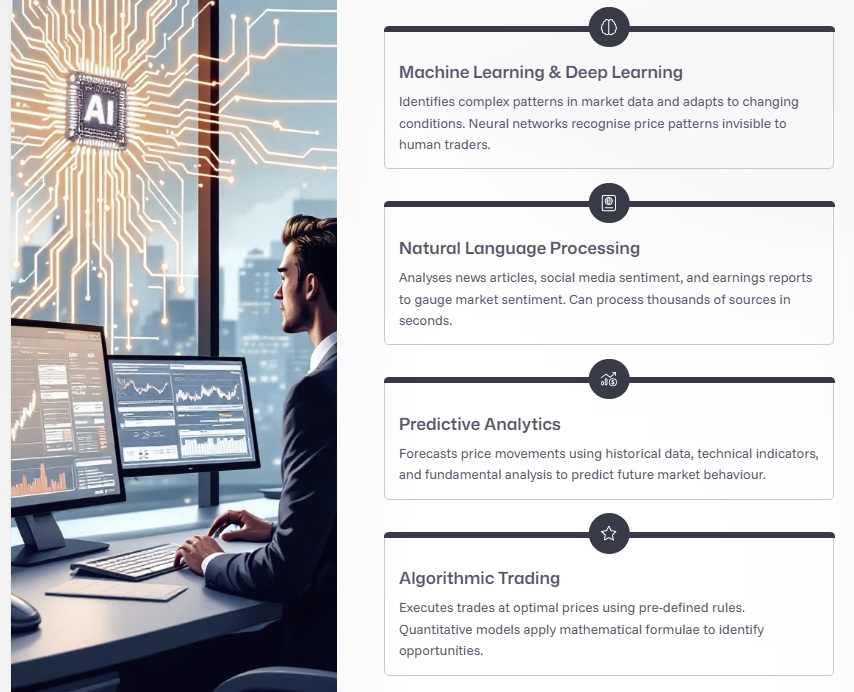
Another powerful tool is Natural Language Processing (NLP), which enables AI to scan and interpret news articles, earnings reports, analyst commentary, and even social media sentiment—processing thousands of sources in seconds. This allows traders to gauge real-time market sentiment and spot emerging narratives before they impact prices.
Complementing these technologies is Predictive Analytics, which combines historical price data, technical indicators, and fundamental analysis to forecast future price movements with high probability. This forward-looking insight helps traders anticipate market behavior rather than simply react to it.
Finally, Algorithmic Trading integrates AI-driven signals with predefined execution rules to place trades at optimal prices. These systems use quantitative models—mathematical formulas and statistical analysis—to identify arbitrage opportunities, manage risk, and automate entry and exit points with precision.
Together, these technologies form the backbone of StocksScanner capabilities, empowering traders to navigate markets more intelligently and effectively than ever before.
Steps to Build a Winning AI Trading Strategy
Building a successful AI trading strategy begins with data collection—the cornerstone of any intelligent system. This includes gathering historical price data, economic indicators, earnings reports, news sentiment, and even social media chatter, all of which help provide context and depth to market behavior. Once quality data is secured, the next step is strategy development. This can involve creating rule-based systems, training machine learning or deep learning models, or using advanced techniques like genetic algorithms to evolve trading logic over time. These models are designed to detect patterns, optimize decision-making, and adapt to changing market dynamics.
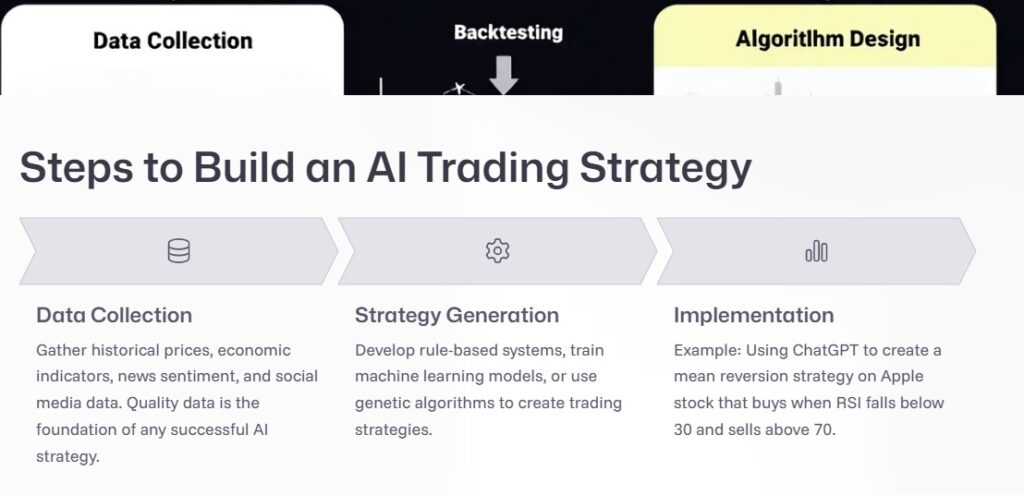
After the strategy is built, it moves to implementation. For example, you could use a tool like ChatGPT to help code a mean reversion strategy on Apple stock—one that automatically buys when the RSI drops below 30 and sells when it rises above 70. Once tested and validated, the strategy can be deployed through a trading platform or bot interface, allowing AI to execute trades based on the predefined logic. By following this process, traders create robust, adaptive systems that combine human insight with machine precision.
You are not a data scientist : And You Don’t Have to Be. Explore StocksScanner
Not every trader has the time, skills, or resources to build complex machine learning models or sift through massive datasets to find the next high-probability trade. The reality is, most retail investors aren’t coders or quant analysts—they’re individuals who want smarter tools to make better decisions, without getting lost in technical complexity.
That’s exactly where StocksScanner comes in
StocksScanner is an End-of-Day (EOD) AI stock screener and picker designed for real-world traders—not data scientists. Instead of asking you to build models or backtest formulas, our platform does the heavy lifting. Every day, our AI analyzes thousands of stocks using a powerful combination of fundamental filters, technical signals, news sentiment, and macroeconomic data. The result? A refined, ranked list of high-potential stocks delivered to you—complete with an AI Confidence Score that quantifies how likely the trade is to succeed.
The AI Confidence Score is not just a random number. It’s a statistically driven metric that expresses the AI’s conviction behind each stock idea, based on historical performance and current market conditions. Whether the AI detects a bullish setup, earnings momentum, or a pattern in volume spikes, you get a clear percentage score to help you evaluate the trade’s potential—no guesswork involved.
And unlike many trading bots that blindly execute trades, StocksScanner leaves you in full control. We don’t place trades for you—we empower you with actionable insights. You decide what to trade, when to act, and how much risk to take.
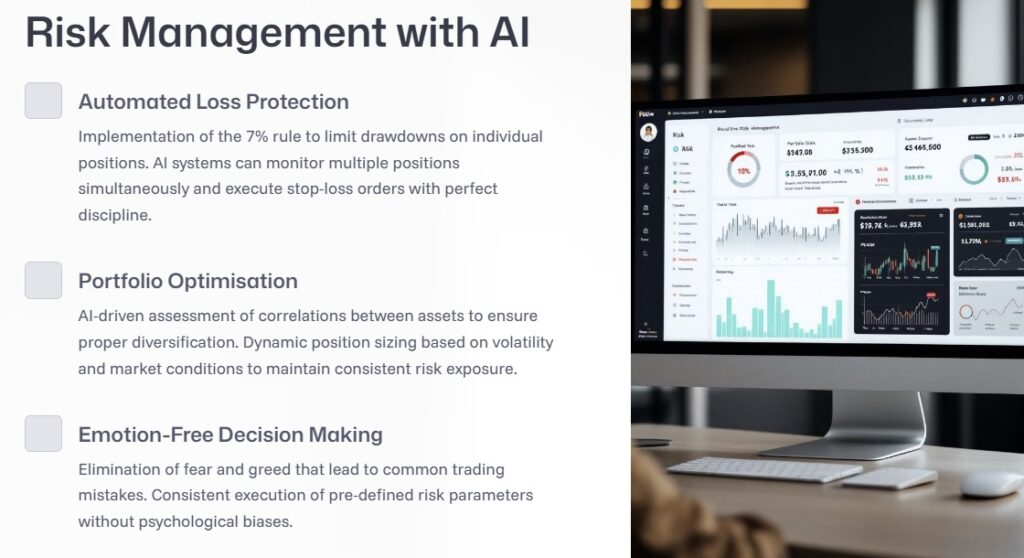
We also integrate risk management into our strategy, highlighting not just high-potential stocks, but also warning signs and volatility profiles to help you make balanced decisions. Our goal isn’t just to help you find the next breakout—it’s to help you trade more confidently, intelligently, and sustainably.
Why Confidence Scores Matter in an AI Stock Trading Strategy
Confidence scores add crucial transparency to the usually opaque processes of machine learning. While AI models are powerful, they are often referred to as “black boxes” due to the complexity of their internal logic. A confidence score pulls back the curtain slightly by giving traders an interpretable output that helps inform how much weight to place on each signal.
Consider two different buy signals for a stock—one with 92% confidence and another with 67%. Both may be technically sound, but the former implies greater statistical backing from the model’s training data. This enables investors to prioritise high-confidence opportunities and limit exposure to lower-confidence trades, thereby enhancing risk management and potentially improving returns over time.
Balancing Confidence with Market Context
Behind every confidence score lies a complex web of machine learning processes. Most trading algorithms are built upon supervised learning models, which are trained on vast volumes of historical data. These models learn to associate certain inputs—like moving averages, volume spikes, or earnings surprises—with profitable outcomes. Once trained, the model estimates the probability that a given pattern will repeat and attaches a corresponding confidence score. While high confidence scores are attractive, they shouldn’t be the only factor driving your trades. Markets are dynamic, influenced by events outside of historical patterns and algorithms. Earnings announcements, geopolitical tensions, and unexpected regulatory changes can quickly turn a high-confidence prediction into a misfire. Effective traders blend AI insights with real-world context, fundamental analysis, and market sentiment.
Over time, the model continues to refine its scoring system through feedback loops. When predictions prove correct, the learning weights are reinforced; when they miss, the algorithm recalibrates. This constant evolution allows AI systems to become better attuned to market nuances and shifts in trading behaviour, while also making their scores more reliable.
This hybrid approach—combining human oversight with AI-generated data—has emerged as a best practice in building sustainable, profitable stock strategies.
The Future of AI Confidence Scores in Investing
As machine learning continues to mature, confidence scores will become more precise, incorporating real-time data feeds, geopolitical analysis, and even behavioural finance cues. We can expect increased personalisation where AI models tailor scores based on an individual investor’s risk appetite, trading history, and sector preferences.
Moreover, regulators may develop guidelines to ensure transparency and fairness in AI predictions, preventing unscrupulous use of biased data or unverified signals. Investors will also become more educated in questioning and interpreting AI metrics, creating a healthier, more adaptive ecosystem for algorithmic trading.
Conclusion: Harnessing AI for Strategic Advantage
The intersection of artificial intelligence and finance is no longer speculative—it’s here, and it’s reshaping how we trade. Incorporating AI confidence scores into your AI stock trading strategy equips you with quantifiable, data-rich insights that support smarter, faster, and more informed decisions. By understanding how these scores are generated and integrating them thoughtfully into your portfolio approach, you can gain a measurable edge in increasingly complex markets. As algorithms evolve, those who embrace and interpret AI tools intelligently will be best positioned to thrive in the future of stock investing.